

If you have ever wondered whether a sentence should contain born or borne, you are not alone. These two words sound alike, come from the same verb, and differ by only one letter. However, they are not interchangeable.
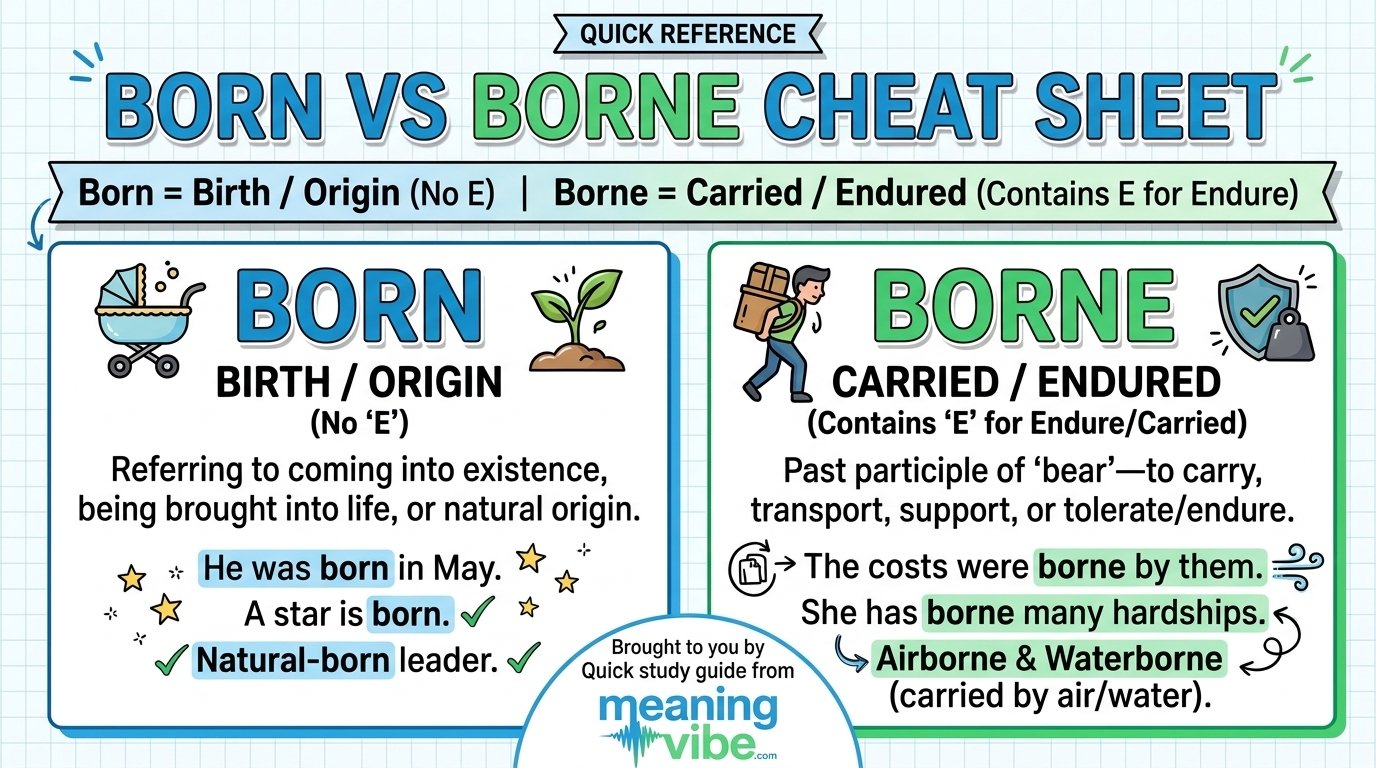
The simplest rule is this: born is normally used when talking about birth or something coming into existence, while borne is generally used for other meanings of the verb bear, such as carrying, supporting, enduring, producing, or transmitting something.
For example, we say, “She was born in Texas,” but “The cost was borne by the company.” We also say, “The idea was born from necessity,” but “The evidence borne out the theory.”
There is one important exception. When the mother is the subject and the sentence describes her giving birth, borne can be correct: “She had borne three children.” Cambridge, Scribbr, and other authoritative grammar resources recognize this distinction.
This guide explains born vs borne from the basic rule to advanced usage. You will learn the difference between bear, bore, born, and borne, how to use each word in a sentence, why phrases such as born out of and borne out are different, and how to avoid the most common mistakes.
Born vs Borne: Quick Answer
Born is used primarily for birth, being brought into existence, or an innate quality.
Borne is used for most other meanings of bear, including carrying, enduring, supporting, producing, or transmitting something.
| Word | Main Use | Example |
|---|---|---|
| Born | Birth or coming into existence | She was born in California. |
| Born | Natural or innate quality | He is a born leader. |
| Born | Origin of an idea or movement | The movement was born from frustration. |
| Borne | Carried or transported | The goods were borne across the river. |
| Borne | Endured or tolerated | She had borne the pain for years. |
| Borne | Supported or paid | The cost was borne by the company. |
| Borne | Produced results | The project has borne fruit. |
| Borne | Confirmed by evidence | The theory was borne out by research. |
The One-Sentence Rule
A useful starting point is:
Use born for birth and coming into existence; use borne for carrying, enduring, supporting, producing, transmitting, and most other meanings of bear.
This rule covers most everyday situations, but it is important to understand the childbirth exception and several fixed expressions before relying on it completely.
What Does Born Mean?
Born is a past participle of bear used specifically in the sense of birth. In modern English, it appears most commonly in the passive construction be born.
Examples include:
- I was born in 1998.
- She was born in Chicago.
- They were born on the same day.
- The child was born healthy.
- He was born into a wealthy family.
Cambridge explains that born is used in the expression be born when referring to a child entering the world. It also notes that was born and were born are the normal forms for discussing when or where someone began life.
Born for Birth
The most important use of born is literal birth.
Correct:
- She was born in New York.
- My brother was born in July.
- The twins were born yesterday.
- He was born to immigrant parents.
- She was born into a musical family.
Incorrect:
- She was borne in New York.
- My brother was borne in July.
- The twins were borne yesterday.
When the sentence describes the child entering the world, born is the normal choice.
Born for Figurative Creation
Born can also describe something that comes into existence figuratively.
For example:
- The idea was born from necessity.
- A new movement was born out of public frustration.
- The company was born from a simple idea.
- Her confidence was born through years of experience.
- The partnership was born out of mutual respect.
Here, nothing is literally being carried. The word born expresses the idea of something being created or coming into existence.
This is why born out of is correct when something originates from a particular condition or situation.
Born as an Adjective
Born can function as an adjective to describe something associated with birth or an innate quality.
Examples include:
- a born leader
- a born writer
- a born athlete
- a French-born artist
- a Texas-born musician
- a firstborn child
- a newborn baby
In a born leader, the meaning is not that the person has literally been delivered as a leader. It means leadership appears to be a natural or innate quality.
Born in Compound Expressions
You will frequently see born in compound words and expressions.
Examples:
| Expression | Meaning |
|---|---|
| firstborn | The first child in a family |
| newborn | Recently born |
| born leader | Someone naturally suited to leadership |
| French-born | Born in France |
| American-born | Born in the United States |
| born and bred | Born and raised in a particular place |
| born again | Literally reborn or, in religious use, spiritually renewed |
These forms are all connected with birth, origin, or characteristics associated with birth.
What Does Borne Mean?
Borne is the other past participle form of bear. It is used for meanings other than the special birth-related use represented by born.
Depending on context, borne can mean:
- carried
- transported
- supported
- endured
- tolerated
- accepted
- produced
- transmitted
- confirmed
Cambridge identifies bear → bore → borne as the verb pattern for meanings such as tolerating or carrying something.
Borne for Carrying
Use borne when something is carried or transported.
Examples:
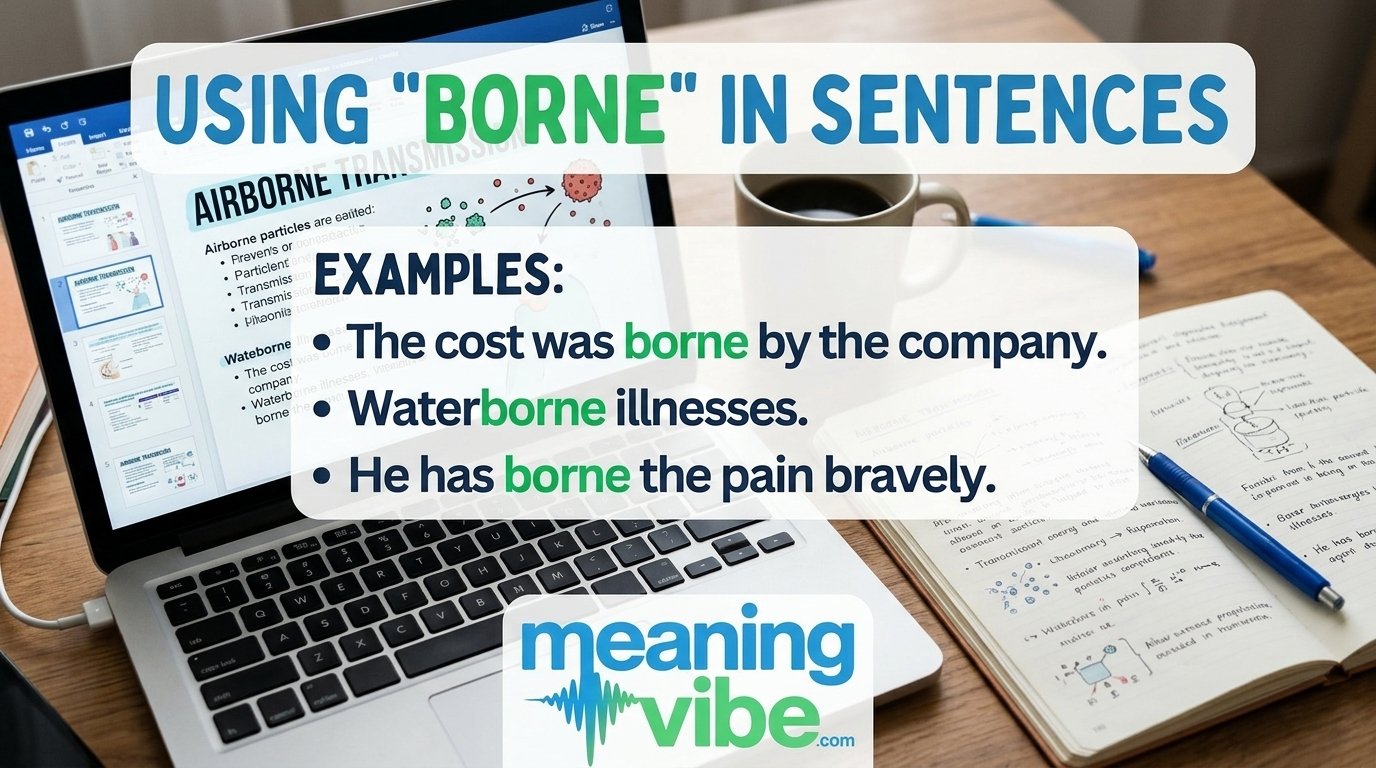
- The injured man was borne into the room.
- The goods were borne across the mountains.
- The statue was borne through the streets.
- The message was borne from one village to another.
In these sentences, borne relates to movement or carrying.
A useful substitution test is to ask whether carried would make sense.
For example:
The responsibility was borne by the manager.
The meaning is close to:
The responsibility was carried by the manager.
This is not a perfect replacement in every context, but it is a useful practical clue.
Borne for Enduring Something
Borne is also used when someone experiences, tolerates, or endures something difficult.
Examples:
- She had borne the pain silently.
- He could no longer bear the pressure.
- They had borne years of hardship.
- The family had borne the financial burden.
- The suffering was difficult to bear.
The expression bear the burden means to accept or endure responsibility, difficulty, or pressure.
Its past participle is borne:
The burden was borne by the entire team.
Borne for Supporting or Paying
Borne can describe a cost, responsibility, or burden that is accepted or paid by someone.
Examples:
- The additional cost was borne by the customer.
- The company has borne the expense.
- The financial burden was borne by taxpayers.
- The responsibility was borne by the manager.
This is a common formal use of borne, especially in business, legal, academic, and professional writing.
Borne for Producing Results
Borne appears in the expression bear fruit, which means to produce useful or successful results.
The past participle is:
borne fruit
Examples:
- Her hard work has borne fruit.
- The investment eventually bore fruit.
- Their efforts have finally borne fruit.
The incorrect form is:
Her hard work has born fruit.
The correct form is:
Her hard work has borne fruit.
The meaning here is “produced results,” not “given birth.”
Borne for Being Confirmed
Another important expression is borne out.
Borne out means supported or confirmed by evidence.
Examples:
- The results were borne out by further research.
- His prediction was borne out by the evidence.
- The investigation bore out her concerns.
- Their fears were borne out by subsequent events.
This is different from born out of, which means originated from.
Born vs Borne: The Core Difference
The distinction becomes much easier when you connect each word with its meaning rather than memorizing spelling alone.
Comparison of Born and Borne
| Feature | Born | Borne |
|---|---|---|
| Main association | Birth | Carrying or enduring |
| Verb | Bear | Bear |
| Special past participle use | Birth | Other meanings |
| Common construction | Be born | Have borne |
| Meaning | Entered the world | Carried, endured, supported, etc. |
| Example | She was born in Boston. | She has borne the responsibility. |
| Common adjective | Born leader | Airborne |
| Common phrase | Born out of | Borne out |
| Compound forms | Firstborn | Waterborne |
| Typical question | Where was someone born? | What was carried or endured? |
The Most Important Difference
Think of born as the birth-specific form.
Think of borne as the general form for other meanings of bear.
For example:
She was born in Florida.
The sentence describes birth.
She has borne the responsibility for years.
The sentence describes enduring or carrying responsibility.
That difference in meaning determines the spelling.
Bear, Bore, Born, and Borne Explained
Many mistakes happen because learners try to understand born and borne without understanding the verb bear.
The basic verb forms are unusual because bear has two past participle forms with different functions.
Bear
Bear is the base form.
It can mean:
- carry
- support
- tolerate
- endure
- produce
- give birth
- accept responsibility
Examples:
- I cannot bear the noise.
- She can bear the pressure.
- The tree will bear fruit.
- The bridge can bear the weight.
- She will bear the responsibility.
Bore
Bore is the simple past form of bear.
Examples:
- She bore the responsibility alone.
- The tree bore fruit last year.
- He bore the pain without complaining.
- The bridge bore the weight safely.
Do not confuse this bore with the adjective bored.
In the sentence:
She bore the responsibility.
Bore is the past tense of bear.
In:
She was bored.
Bored means uninterested.
Borne
Borne is the past participle used for most meanings of bear.
Examples:
- She has borne the responsibility.
- The cost was borne by the company.
- The evidence has borne out the theory.
- The disease is borne by mosquitoes.
- Their efforts have borne fruit.
Born
Born is the past participle used in the special birth-related sense.
Examples:
- She was born in 2001.
- They were born in Canada.
- He was born into a large family.
- The idea was born from necessity.
The distinction is therefore not based simply on tense. It is based on meaning and grammatical use.
Why Does Bear Have Both Born and Borne?
The two forms developed as different ways of representing different meanings of the same verb.
Modern English maintains a practical distinction:
born is associated with birth and coming into existence, while borne represents other meanings of bear.
Historical dictionary sources also document this distinction. The older Webster dictionary, for example, described born in connection with being brought into life and contrasted it with borne in the sense of being carried.
Modern dictionaries similarly distinguish born as the birth-related form and borne as the general past participle of bear.
You do not need to memorize the historical development to use the words correctly. What matters in modern writing is recognizing the meaning of bear in the sentence.
When Should You Use Born?
Use born when the sentence concerns birth or something coming into existence.
Use Born for Literal Birth
Examples:
- I was born in 1995.
- She was born in California.
- The baby was born yesterday.
- They were born at the same hospital.
- He was born to young parents.
Use Born for Origin
Use born when an idea, movement, organization, or feeling comes into existence.
Examples:
- The organization was born from a desire to help children.
- The movement was born out of frustration.
- Her interest in science was born during childhood.
- The partnership was born from a shared goal.
Use Born for Natural Qualities
Examples:
- She is a born leader.
- He is a born storyteller.
- She was a born performer.
- He is a born athlete.
Here, born means something like naturally suited or possessing an ability from birth.
When Should You Use Borne?
Use borne when bear means something other than birth-related coming into existence.
Use Borne for Carrying
Examples:
- The soldiers were borne away from the battlefield.
- The supplies were borne across the river.
- The statue was borne through the city.
Use Borne for Endurance
Examples:
- She had borne the hardship for years.
- He has borne considerable pressure.
- They had borne the consequences of the decision.
- The family bore the loss with dignity.
Use Borne for Costs
Examples:
- The cost was borne by the employer.
- The expenses were borne by the organization.
- The additional charge will be borne by the customer.
Use Borne for Production
Examples:
- The effort has borne fruit.
- Their investment bore fruit.
- The experiment has borne unexpected results.
Use Borne for Transmission
Examples:
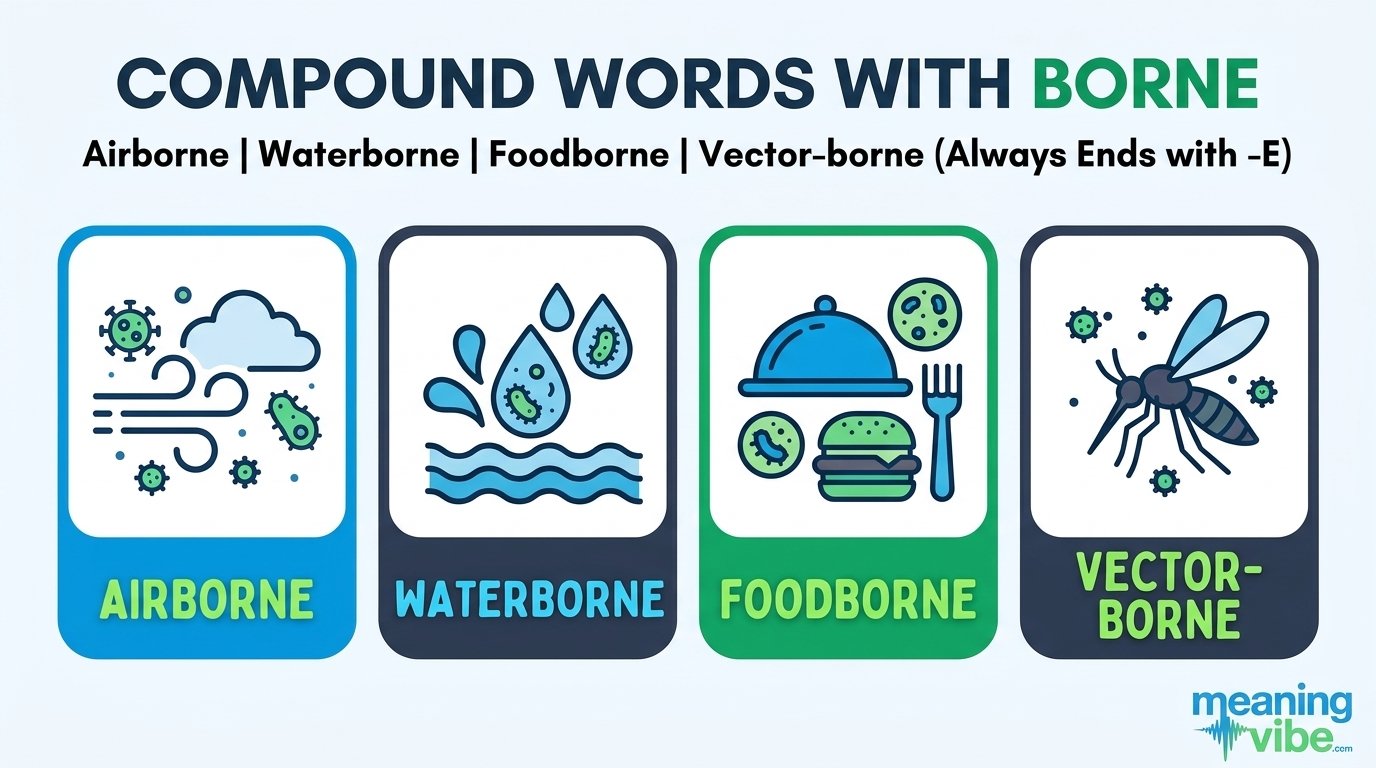
- The disease is airborne.
- The infection may be bloodborne.
- Certain illnesses are foodborne.
- The virus may be waterborne.
In these compounds, -borne carries the meaning of being carried or transmitted through something.
The Important Childbirth Exception
This is the area where simple explanations of born vs borne can become misleading.
It is correct to say:
She was born in 1990.
But if the mother is the subject and the sentence means that she gave birth to children, borne can be correct:
She had borne three children.
Scribbr specifically identifies this as an exception to the basic birth rule, while Cambridge explains that bear can be used for giving birth, particularly in more formal contexts.
Born When the Child Is the Subject
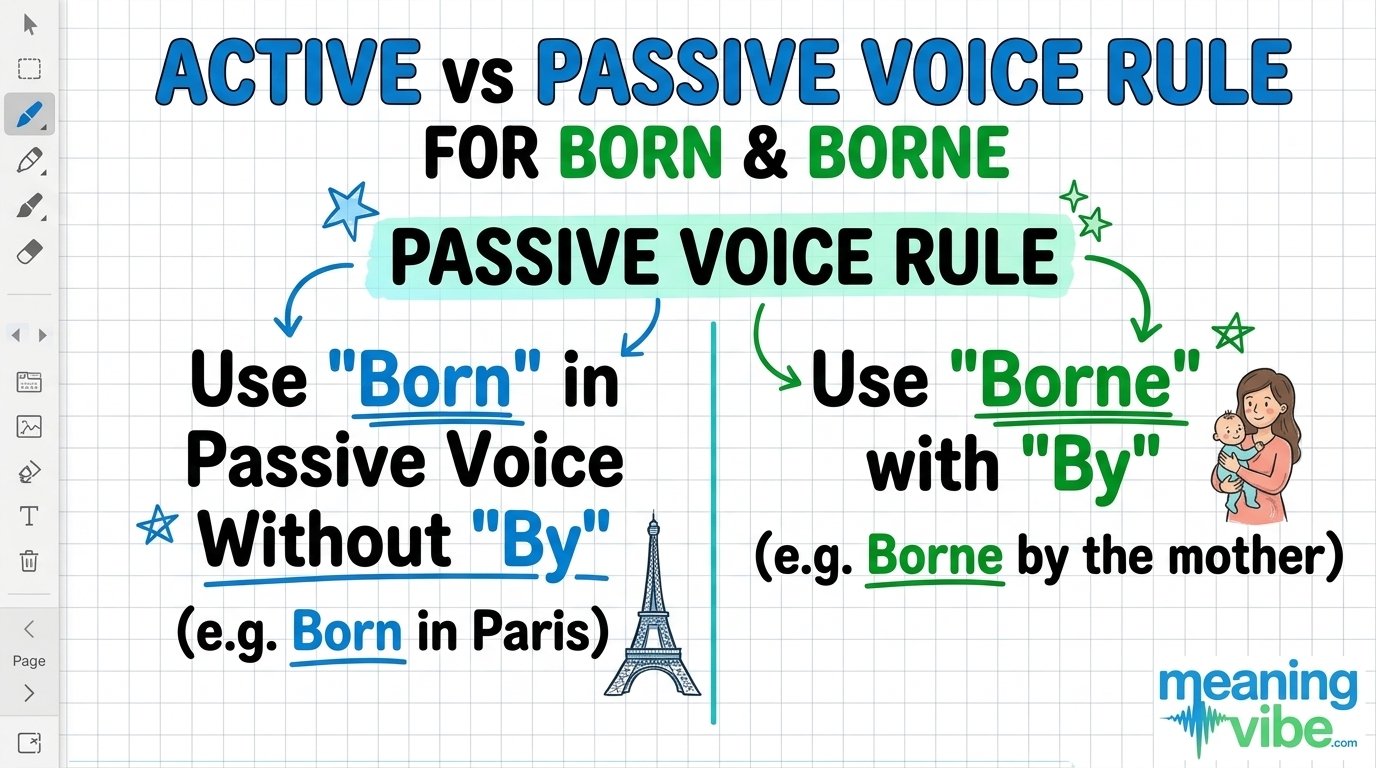
Use born when the child is the grammatical subject of the passive construction.
Examples:
- The child was born in May.
- She was born in Boston.
- The twins were born early.
- He was born into a large family.
The child is the one who is described as entering the world.
Borne When the Mother Is the Subject
Use borne when the mother is the subject and bear means giving birth.
Examples:
- She had borne three children.
- The queen had borne several heirs.
- The woman had borne a child before moving abroad.
This construction is more formal than ordinary everyday alternatives.
In casual American English, speakers are often more likely to say:
She had three children.
or:
She gave birth to three children.
However, borne is grammatically appropriate when the verb bear is deliberately used.
Why “I Was Borne” Is Usually Wrong
Consider:
I was born in Texas.
This is the normal expression.
Although borne can refer to being carried, I was borne in Texas does not normally communicate ordinary birth. It sounds archaic or suggests being physically carried.
Therefore, for ordinary birth, use:
I was born in Texas.
Born Out of vs Borne Out
These two expressions are frequently confused because they look almost identical.
They have completely different meanings.
Born Out Of
Born out of means originating from or developing because of something.
Examples:
- The idea was born out of necessity.
- The movement was born out of public frustration.
- The project was born out of a desire to improve education.
- Her confidence was born out of years of experience.
Think:
born out of = originated from
Borne Out
Borne out means confirmed, supported, or shown to be true by evidence.
Examples:
- The theory was borne out by the evidence.
- His concerns were borne out by the investigation.
- Their predictions were borne out by later results.
- The original assumption was not borne out by the data.
Think:
borne out = confirmed
Born Out of vs Borne Out Comparison
| Expression | Meaning | Example |
|---|---|---|
| born out of | Originated from | The idea was born out of necessity. |
| borne out | Confirmed by evidence | The theory was borne out by research. |
A simple memory trick is:
Born out of → something was created from something.
Borne out → something was confirmed by evidence.
Grammarly and Scribbr both highlight this distinction.
Borne Fruit vs Born Fruit
The correct phrase is:
borne fruit
It comes from the verb phrase bear fruit, meaning to produce results.
Examples:
- Her efforts have borne fruit.
- The investment finally bore fruit.
- Their hard work has borne fruit.
Do not write:
Her efforts have born fruit.
That would incorrectly apply the birth-related form to the meaning “produce.”
Why Borne Is Correct
A tree can bear fruit, meaning it produces fruit.
Therefore:
- present: bear fruit
- past: bore fruit
- past participle: borne fruit
The meaning has nothing to do with birth.
Borne in Mind vs Born in Mind
The correct expression is:
borne in mind
It means remembered or taken into consideration.
Example:
This limitation should be borne in mind when interpreting the results.
Another example:
The cost should be borne in mind before making a decision.
The expression comes from the idea of mentally carrying or holding something in consideration.
Born in mind is incorrect in this idiomatic use.
Born Leader vs Borne Leader
The correct expression is:
born leader
A born leader is someone who seems naturally suited to leadership.
Examples:
- She is a born leader.
- He has always been a born leader.
- The young captain proved to be a born leader.
Borne leader is incorrect because the expression concerns a natural quality associated with birth.
Born and Bred
Born and bred means born and raised in a particular place or environment.
Examples:
- She is a New Yorker, born and bred.
- He is a Texas-born and bred musician.
- I am a local, born and bred.
The phrase contains born, not borne, because it concerns birth and upbringing.
Airborne, Waterborne, Foodborne, and Bloodborne
The suffix -borne is important because it shows how borne relates to the meaning “carried.”
Airborne
Airborne means carried or transmitted through the air.
Example:
Some infections can spread through airborne particles.
Waterborne
Waterborne means carried or transmitted through water.
Example:
Clean water helps prevent waterborne diseases.
Foodborne
Foodborne means transmitted through contaminated food.
Example:
Proper food handling reduces the risk of foodborne illness.
Bloodborne
Bloodborne means transmitted through blood.
Example:
Healthcare workers follow precautions against bloodborne pathogens.
These compounds are not related to birth. They use borne because something is being carried or transmitted.
Born vs Borne in Common Sentences
The fastest way to understand the difference is to compare similar sentence structures.
Examples Using Born
- She was born in Chicago.
- He was born in 1990.
- They were born into a large family.
- The child was born healthy.
- She is a born leader.
- The movement was born from dissatisfaction.
- The idea was born out of necessity.
- He was born and bred in Texas.
- She is a Canadian-born writer.
- The firstborn child inherited the estate.
Examples Using Borne
- The cost was borne by the company.
- She had borne the responsibility for years.
- The evidence was borne out by the results.
- Their efforts have borne fruit.
- The disease is airborne.
- The illness may be foodborne.
- The virus can be bloodborne.
- The supplies were borne across the river.
- He had borne the pain quietly.
- The burden was borne by the entire team.
Incorrect vs Correct Examples
| Incorrect | Correct | Why |
|---|---|---|
| I was borne in New York. | I was born in New York. | Birth |
| She was born the cost. | She bore the cost. | Past tense of bear |
| The cost was born by the company. | The cost was borne by the company. | Cost was carried/accepted |
| Her efforts have born fruit. | Her efforts have borne fruit. | Produced results |
| The theory was born out by evidence. | The theory was borne out by evidence. | Confirmed |
| The idea was borne out of necessity. | The idea was born out of necessity. | Originated from |
| She has born three children. | She has borne three children. | Mother is subject |
| He is a borne leader. | He is a born leader. | Natural ability |
| It should be born in mind. | It should be borne in mind. | Idiom |
| The disease is airborn. | The disease is airborne. | Carried through air |
| It is waterborn. | It is waterborne. | Carried through water |
| The illness is foodborn. | The illness is foodborne. | Transmitted through food |
A Simple Decision Test for Born vs Borne

When you are unsure, do not focus on spelling first. Focus on meaning.
Step 1: Is the sentence about birth?
If yes, use born in the normal passive construction.
She was born in Miami.
Step 2: Is something coming into existence figuratively?
If yes, born may be appropriate.
The idea was born from necessity.
Step 3: Does the verb mean carried?
If yes, use borne.
The supplies were borne across the river.
Step 4: Does it mean endured or tolerated?
Use borne.
She had borne the pressure for years.
Step 5: Does it mean supported or paid?
Use borne.
The cost was borne by the organization.
Step 6: Does it mean produced?
Use borne.
Their work has borne fruit.
Step 7: Does it mean confirmed?
Use borne out.
The evidence borne out the theory.
More precisely, in a finite past-tense construction you would say:
The evidence bore out the theory.
And in a passive perfect construction:
The evidence has borne out the theory.
The grammatical form matters as well as the meaning.
Step 8: Is the mother the subject and is she giving birth?
Borne can be correct.
She had borne four children.
This is the key exception to remember.
Born vs Borne and Active vs Passive Voice
Understanding voice makes the childbirth distinction easier.
Passive Birth Construction
The standard construction is:
The child was born.
The child is the subject, but the meaning is that the child came into the world through birth.
This is why born is used.
Active Childbirth Construction
When the mother is the subject:
She bore a child.
Past tense:
She bore a child.
Perfect construction:
She has borne a child.
This is bear → bore → borne.
The distinction is therefore partly grammatical and partly semantic.
Practical Comparison
| Sentence | Correct? | Explanation |
|---|---|---|
| The baby was born yesterday. | Yes | Passive birth |
| She was born yesterday. | Yes | Passive birth |
| She bore a child. | Yes | Mother actively gave birth |
| She has borne three children. | Yes | Mother actively gave birth |
| She was borne yesterday. | Usually no | Not the normal birth construction |
| She has born three children. | No | Perfect active form requires borne |
This distinction is supported by grammar references including Cambridge and Scribbr.
How to Remember Born vs Borne
The Birth Test
Ask:
Is the sentence about someone entering the world?
If yes, think born.
He was born in California.
The Carry Test
Ask:
Could the meaning involve carrying, supporting, enduring, producing, or transmitting?
If yes, think borne.
The cost was borne by the company.
The Evidence Test
If you see out and the meaning is “confirmed,” think:
borne out
Example:
The results borne out the prediction.
But remember the tense:
The results bore out the prediction.
The results have borne out the prediction.
The Origin Test
If you see out of and the meaning is “originated from,” use:
born out of
Example:
The project was born out of necessity.
The Mother Test
If a mother is the subject and bear means give birth:
She had borne three children.
This is the exception worth memorizing.
Common Mistakes to Avoid
Mistake: Using Borne for Ordinary Birth
Incorrect:
I was borne in Los Angeles.
Correct:
I was born in Los Angeles.
Unless the sentence specifically means that someone physically carried you, born is the normal word for birth.
Mistake: Using Born for Costs
Incorrect:
The cost was born by the customer.
Correct:
The cost was borne by the customer.
The cost was carried or accepted by the customer.
Mistake: Confusing Born Out of and Borne Out
Incorrect:
The theory was born out by the evidence.
Correct:
The theory was borne out by the evidence.
But:
The theory was born out of earlier research.
The first means confirmed. The second means originated from.
Mistake: Writing Born Fruit
Incorrect:
Their efforts have born fruit.
Correct:
Their efforts have borne fruit.
The phrase means that their efforts produced results.
Mistake: Writing Born in Mind
Incorrect:
This should be born in mind.
Correct:
This should be borne in mind.
The phrase means that something should be remembered or considered.
Mistake: Forgetting the Tense of Bear
Consider:
She bore the responsibility.
This is simple past.
But:
She has borne the responsibility.
This is a present perfect construction.
Therefore, borne should not automatically replace bore just because the sentence is about carrying or enduring.
Born vs Borne Grammar Table
| Meaning | Present | Past | Past Participle |
|---|---|---|---|
| Carry/endure | bear | bore | borne |
| Produce | bear | bore | borne |
| Support | bear | bore | borne |
| Confirm | bear out | bore out | borne out |
| Give birth | bear | bore | borne |
| Be brought into the world | be born | was/were born | born |
The final row is different because be born is the standard birth construction.
Born vs Borne for English Learners
For English learners, the biggest problem is that born and borne sound alike.
They Are Homophones
In standard modern English pronunciation, born and borne are pronounced alike or very similarly in major varieties of English.
This means you cannot reliably choose the spelling from pronunciation.
You must look at the meaning and grammatical context.
Wordsmyth also identifies born and borne as homophones with different meanings.
Learn the Word in a Phrase
Instead of memorizing:
born = one word
borne = another word
learn common combinations:
- was born
- were born
- born in
- born into
- born out of
- born leader
- borne by
- borne fruit
- borne out
- borne in mind
- airborne
- waterborne
- foodborne
- bloodborne
This makes correct usage much more automatic.
Born vs Borne: Quick Reference Chart
| If You Mean… | Use |
|---|---|
| Entered the world | born |
| Was delivered at birth | born |
| Originated | Usually born |
| Naturally talented | born |
| Carried | borne |
| Transported | borne |
| Endured | borne |
| Tolerated | borne |
| Supported | borne |
| Paid by someone | borne |
| Produced results | borne |
| Confirmed by evidence | borne out |
| Transmitted through air | airborne |
| Transmitted through water | waterborne |
| Transmitted through food | foodborne |
| Transmitted through blood | bloodborne |
| Mother actively gives birth | borne |
Practice Quiz: Born or Borne?
Choose born or borne for each sentence.
Questions
- She was ___ in Boston.
- The cost was ___ by the company.
- His efforts have ___ fruit.
- The movement was ___ out of frustration.
- The theory was ___ out by the evidence.
- She had ___ three children.
- He is a ___ leader.
- The disease is ___ through contaminated food.
- The responsibility was ___ by the manager.
- They were ___ into a large family.
- The supplies were ___ across the river.
- The idea was ___ from necessity.
- It should be ___ in mind.
- The twins were ___ in 2005.
- The company has ___ the expense.
- The results ___ out his prediction.
- The results have ___ out his prediction.
- She ___ the burden for many years.
- The child was ___ in Texas.
- The illness is ___ through water.
Answers and Explanations
| # | Answer | Explanation |
|---|---|---|
| 1 | born | Birth |
| 2 | borne | Cost was carried/accepted |
| 3 | borne | Produced results |
| 4 | born | Originated from |
| 5 | borne | Confirmed by evidence |
| 6 | borne | Mother is the subject |
| 7 | born | Natural quality |
| 8 | borne | Transmitted through food |
| 9 | borne | Responsibility was carried |
| 10 | born | Birth/origin |
| 11 | borne | Physically carried |
| 12 | born | Originated |
| 13 | borne | Fixed expression |
| 14 | born | Birth |
| 15 | borne | Expense was accepted |
| 16 | bore | Simple past of bear out |
| 17 | borne | Present perfect of bear out |
| 18 | bore | Simple past of bear |
| 19 | born | Birth |
| 20 | borne | Transmitted through water |
Notice that questions 16 and 17 require more than choosing between born and borne. The correct answer depends on tense:
The results bore out his prediction.
The results have borne out his prediction.
That is why learning the entire bear → bore → borne pattern is more useful than memorizing a single spelling rule.
Frequently Asked Questions About Born vs Borne
What is the difference between born and borne?
Born is normally used for birth or coming into existence. Borne is used for most other meanings of bear, including carrying, enduring, supporting, producing, and transmitting.
Is it “born or borne”?
It depends on the meaning. Use born for ordinary birth, such as “She was born in Texas.” Use borne for meanings such as carrying or enduring, such as “The cost was borne by the company.”
Is borne the past participle of bear?
Yes. Borne is a past participle of bear and is used for most meanings of the verb. Born is the special past participle used in the birth-related sense.
Is born the past participle of bear?
Yes, but specifically in the birth-related sense. The normal construction is be born, as in “He was born in 2000.”
What is the past tense of bear?
The simple past of bear is bore.
For example:
She bore the responsibility alone.
The past participle is borne:
She has borne the responsibility alone.
Are born and borne homophones?
Yes. They are pronounced alike in standard modern English usage, although their spellings and meanings differ.
Is “I was born” correct?
Yes. I was born is the standard construction for talking about your birth.
Is “I was borne” correct?
Usually not if you mean that you were born. I was borne can theoretically describe being carried, but it is not the normal expression for birth.
Is “she has born a child” correct?
No. When the mother is the subject and bear means give birth, the correct perfect form is:
She has borne a child.
Is “she has borne a child” correct?
Yes. It is grammatically correct and means that she has given birth to a child.
Is “she was borne” ever correct?
It can be correct when borne means carried, but it is not the standard expression for saying that a woman or child was born.
What does “born out of” mean?
Born out of means originating from or developing because of something.
Example:
The organization was born out of a need for better education.
What does “borne out” mean?
Borne out means confirmed or supported by evidence.
Example:
The hypothesis was borne out by later research.
Is it “born out” or “borne out”?
For the meaning “confirmed,” the expression is borne out when the past participle is required.
Example:
The evidence has borne out the theory.
For simple past, use bore out:
The evidence bore out the theory.
Is “born out of” or “borne out of” correct?
Use born out of when you mean “originated from.”
Example:
The idea was born out of necessity.
Borne out without of means confirmed.
Is it “borne fruit” or “born fruit”?
The correct expression is borne fruit.
Example:
Their efforts have borne fruit.
It means that their efforts have produced results.
Is it “borne in mind” or “born in mind”?
The correct expression is borne in mind.
Example:
The limitation should be borne in mind.
It means the limitation should be remembered or considered.
Is it “born leader” or “borne leader”?
The correct phrase is born leader.
It describes someone who appears naturally suited to leadership.
What does “born and bred” mean?
Born and bred means born and raised in a particular place or environment.
Example:
She is a New Yorker, born and bred.
What does “borne by” mean?
Borne by usually means carried, supported, endured, or paid by someone.
Example:
The cost was borne by the employer.
Why is “airborne” spelled with borne?
Airborne means carried or transmitted through the air. The borne element comes from the carrying sense of bear, not the birth-related sense.
Why is “waterborne” spelled with borne?
Waterborne means carried or transmitted through water. It uses borne because something is being carried through water.
Why is “foodborne” spelled with borne?
Foodborne describes something transmitted through food. The word therefore uses borne, reflecting the meaning “carried.”
Why is “bloodborne” spelled with borne?
Bloodborne means transmitted through blood. Again, borne refers to something being carried or transmitted.
Can born refer to an idea?
Yes. Born can be used figuratively for an idea, movement, organization, or feeling that comes into existence.
Example:
The idea was born from necessity.
Can borne refer to childbirth?
Yes. When bear means give birth and the mother is the subject, borne can be correct.
Example:
She had borne three children.
This is more formal than simply saying that she had three children.
Is “born leader” grammatically correct?
Yes. Born leader is a standard expression describing someone with natural leadership ability.
Is “borne leader” correct?
No, not when you mean a person who naturally has leadership ability. The correct expression is born leader.
What is the easiest way to remember born vs borne?
Use the birth versus carrying test.
If the sentence is about birth or coming into existence, think born. If it is about carrying, enduring, supporting, producing, or transmitting, think borne.
What is the difference between bear, bore, born, and borne?
Bear is the base form, bore is the simple past, and borne is the general past participle. Born is the special past participle used for birth-related constructions.
Is “born from” correct?
Yes. Born from can describe something that originated from another source.
Example:
The movement was born from public dissatisfaction.
Is “borne from” ever correct?
It can occur in contexts where borne retains another meaning of bear, but it should not automatically replace born from when you mean “originated from.” For ordinary expressions of origin, born from is the natural choice.
Is “born into” correct?
Yes.
Example:
She was born into a wealthy family.
It means that she entered the world as a member of that family or social situation.
Is “born to” correct?
Yes.
Example:
He was born to immigrant parents.
It can also appear in the expression:
She was born to be a teacher.
Here it can suggest a natural suitability or destiny.
Is “borne responsibility” correct?
Yes.
Examples:
She has borne responsibility for the project.
The manager bore responsibility for the error.
Is “born responsibility” correct?
No, when you mean responsibility that someone carries or accepts. The correct word is borne in the past participle construction.
Is “borne the burden” correct?
Yes.
Example:
The family has borne the burden for many years.
The phrase comes from bear the burden.
Is “born the burden” correct?
No. The correct forms are:
She bore the burden.
or:
She has borne the burden.
Final Born vs Borne Cheat Sheet
The easiest way to remember the entire topic is to connect each word with a specific meaning.
Born
- birth
- coming into the world
- coming into existence
- origin
- natural qualities
- firstborn
- newborn
- born leader
- born and bred
- born out of
Borne
- carried
- transported
- endured
- tolerated
- supported
- paid
- produced
- transmitted
- borne out
- borne fruit
- borne in mind
- airborne
- waterborne
- foodborne
- bloodborne
Final Decision Table
| If the sentence means… | Correct form |
|---|---|
| Entered the world | born |
| Was delivered | born |
| Originated | born |
| Naturally possessed a quality | born |
| Came into existence | born |
| Was carried | borne |
| Was transported | borne |
| Was endured | borne |
| Was tolerated | borne |
| Was supported | borne |
| Was paid or accepted | borne |
| Produced results | borne |
| Was confirmed | borne out |
| Was transmitted | borne |
| Mother gave birth | borne |
The most important rule is therefore:
Born is primarily the birth-related form of bear. Borne is the general past participle for carrying, enduring, supporting, producing, transmitting, and related meanings.
Remember the important exception: a child is born, but a mother can have borne children.
Key Takeaways
- Born is normally used for birth.
- Born can also describe something coming into existence.
- Born appears in expressions such as born leader, firstborn, and born out of.
- Borne is the general past participle of bear for many other meanings.
- Borne can mean carried, endured, supported, produced, or transmitted.
- Borne out means confirmed by evidence.
- Borne fruit means produced results.
- Borne in mind means remembered or considered.
- Airborne, waterborne, foodborne, and bloodborne use the carrying/transmission sense of borne.
- A mother can have borne children.
- The simple past of bear is bore, not born or borne.
- Because born and borne sound alike, context determines the spelling.
For more practical English grammar guides, continue building the englishhexa commonly confused words and English usage collection around related topics such as bear vs bare, bore vs bored, affect vs effect, past participles, irregular verbs, homophones, and active vs passive voice.