

Have you ever typed the word “speach” and then paused, wondering if it looked right? You are not alone. This is one of the most searched spelling questions in English, and thousands of students, professionals, and content writers type it incorrectly every single day.
The good news is that the answer is simple, and once you understand the reason behind it, you will never make this mistake again.
In this guide, you will learn the correct spelling, the origin of the word, common mistakes people make, and simple tricks to remember it forever.
Speach or Speech – Quick Answer
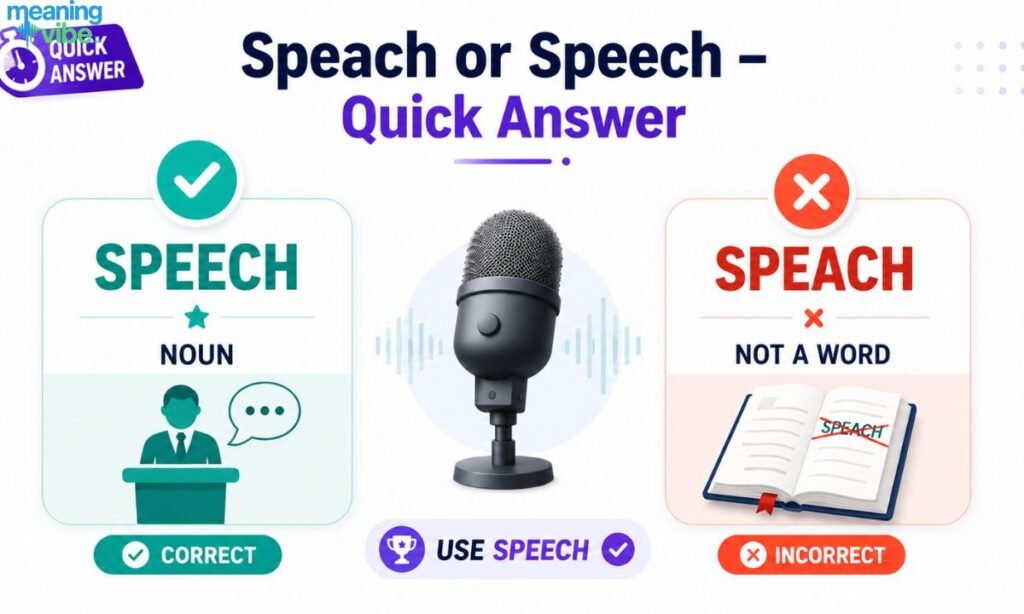
The correct spelling is speech. “Speach” is not a recognized English word and does not appear in any standard dictionary.
Here is the short version:
- Speech = correct ✅
- Speach = incorrect ❌
Speech refers to the ability to talk, express thoughts through spoken words, or a formal talk delivered to an audience. People often misspell it as “speach” because it looks similar to words like “teach,” “reach,” and “preach,” which all end with the “each” pattern. However, “speech” breaks that pattern and uses a double “e” instead.
Speach or Speech in English
In standard English, whether British or American, only one spelling is accepted: speech.
There is no regional variation for this word, unlike other terms such as “color” and “colour.” No English dictionary, including Oxford, Cambridge, or Merriam Webster, lists “speach” as an alternate or informal spelling. It is simply treated as a spelling error.
Here are a few correct examples of how the word is used in everyday English:
- The teacher asked us to prepare a short speech for class.
- Her speech at the wedding brought everyone to tears.
- Freedom of speech is protected under many constitutions.
- His speech was slow and clear, making it easy to understand.
Speach or Speech Therapy
This is one of the biggest reasons people search for this term online. Parents, teachers, and caregivers often want information about a child’s speaking development, and they type “speach therapy” instead of the correct term.
The correct term is always speech therapy, not “speach therapy.”
Speech therapy refers to the professional treatment given to individuals who have difficulty speaking clearly, forming words, or communicating due to a delay, disorder, or medical condition. A speech language pathologist is the trained professional who provides this kind of support.
Common areas covered under speech therapy include:
- Stuttering and fluency issues
- Articulation and pronunciation difficulties
- Language delay in children
- Voice disorders
- Speech recovery after a stroke or injury
If you or your child ever need this kind of support, always search using the correct spelling, “speech therapy,” to find accurate and trustworthy medical resources.
Speach or Speech for Students
Students frequently need to write or deliver a speech as part of school assignments, debate competitions, or graduation ceremonies. This is another major reason the misspelling “speach” appears so often in search engines, especially from students typing quickly.
If you are a student preparing an assignment, remember that the correct spelling is always speech, whether you are writing about:
- A persuasive speech
- An informative speech
- A graduation speech
- A motivational speech
- A debate speech
A simple memory trick for students is this sentence: “I need to see a good speech.” Both “see” and “speech” contain the double “e,” which makes it easier to recall the correct spelling during exams or while writing essays.
Also Read This: Dammit vs. Damnit: What’s the Difference and Which Is Right? (2026)
Speach or Speech Grammar
From a grammar standpoint, “speech” is primarily used as a noun, though it can take different forms depending on the context.
Here is a simple breakdown:
| Word Form | Example |
| Noun (uncountable) | Speech is a basic human ability. |
| Noun (countable, plural) | She has given three speeches this year. |
| Related verb | To speak (not “to speech”) |
| Adjective form | Speech impaired, speech related |
One important grammar note is that “speech” does not have a standard verb form. You cannot say “I will speech tomorrow.” Instead, the correct verb is “speak,” as in “I will speak tomorrow” or “I will give a speech tomorrow.”
The Origin of Speech
Understanding where the word comes from can help explain why it is spelled the way it is.
The word “speech” originates from the Old English term “spæc” or “spræc,” which meant the act, power, or manner of speaking. This Old English word is closely related to the Proto Germanic root “sprek,” which also gave rise to similar words in other Germanic languages, such as:
- Sprache in German
- Spraak in Dutch
- Sprog in Danish
Over centuries, the spelling evolved through Middle English before settling into the modern form “speech” that we use today. Although the word is related to “speak,” English spelling did not evolve in a perfectly logical or consistent way, which is exactly why so many people assume “speak” and “speech” should share the same “ea” pattern.
British English vs American English Spelling
Many spelling differences exist between British and American English, such as:
| British English | American English |
| Colour | Color |
| Organise | Organize |
| Centre | Center |
| Travelled | Traveled |
However, the word “speech” is an exception. Both British English and American English use the exact same spelling: speech. There is no alternate accepted version in either dialect, which makes this one of the more straightforward words in English despite the common confusion.
Which Spelling Should You Use?
Always use speech. There is no context, whether formal writing, casual conversation, academic work, or professional communication, where “speach” is considered correct.
Here is a simple checklist to confirm you are using the right word:
- Does it refer to talking or a spoken address? Use speech.
- Are you writing an essay, email, or report? Use speech.
- Are you texting quickly and unsure of the spelling? Still use speech.
- Is it appearing in any dictionary as “speach”? No, so avoid it completely.
Common Mistakes with Speech
Even confident English speakers occasionally slip up. Below are the most frequent mistakes people make with this word.
Mistake 1: Confusing It with “Speak”
Many people assume that since “speak” has an “ea,” then “speech” should follow the same pattern. This assumption is incorrect, and the two words simply evolved differently over time.
Mistake 2: Adding an Incorrect Verb Form
Some learners try to use “speech” as a verb, such as “I will speech at the event.” This is grammatically wrong. The correct verb form is “speak,” while “speech” remains a noun.
Mistake 3: Autocorrect Confusion
Typing quickly on a phone can sometimes cause autocorrect to accept “speach” if custom dictionaries have been altered. Always double check important documents manually.
Mistake 4: Mixing Up Plural Forms
The plural of speech is “speeches,” not “speachs” or “speeches” spelled incorrectly. For example: “The speeches at the ceremony were inspiring.”
Speech in Everyday Examples
To fully understand how the word is used, here are some real world style examples across different situations:
- Public speaking: “Her opening speech captured the audience’s attention immediately.”
- Education: “Speech development is an important milestone in early childhood.”
- Politics: “The president’s speech addressed the recent economic changes.”
- Law: “Freedom of speech is a fundamental right in many democratic countries.”
- Daily conversation: “His speech pattern is calm and easy to follow.”
These examples show that “speech” fits naturally into nearly every area of communication, from casual talk to formal public address.
Speech – Google Trends and Usage Data
Search interest around this topic remains consistently high throughout the year, especially during graduation season, election periods, and back to school months when students and professionals frequently need to write or deliver speeches.
Search behavior shows that people commonly look up phrases such as:
- “Is speach a word”
- “Speech or speach correct spelling”
- “How to spell speech properly”
- “Speech vs speach difference”
This consistent search pattern confirms that the misspelling “speach” remains widespread, making it essential to clarify the correct usage for learners, students, and professionals worldwide.
Comparison Table: Speech vs Speach
| Feature | Speech | Speach |
| Correct spelling | Yes | No |
| Found in dictionaries | Yes | No |
| Used in formal writing | Yes | Never |
| Origin | Old English “spæc” | Not applicable |
| Common usage | Talks, addresses, ability to speak | Misspelling only |
| Recommended usage | Always use this | Avoid completely |
Conclusion
The confusion between speach and speech is completely understandable given how tricky English spelling can be. However, the rule is simple and permanent: speech is the only correct spelling, used consistently across British English, American English, academic writing, and everyday conversation.
Whether you are a student preparing a class assignment, a parent researching speech therapy, or a professional writing a public address, remembering this one rule will keep your writing accurate and confident.
Use the memory trick “I need to see a good speech” whenever you feel unsure, and you will never write “speach” again.