

You’re scrolling through your messages when suddenly someone drops “STFU” in the chat. Is it a joke? Are they angry? Should you be offended — or laugh it off? If you’ve ever paused over those four letters, you’re far from alone. In 2026, STFU remains one of the most searched internet slang terms in digital communication — and for good reason. Its meaning can shift from playful teasing to genuine frustration depending entirely on context, tone, and the relationship between the people involved. This complete guide breaks down everything you need to know about STFU in text, from its origin and real-life examples to exactly when it’s safe to use — and when it’s absolutely not.
What Does STFU Stand For?
STFU stands for “Shut The F*** Up.”
It’s a blunt, informal acronym used in text messages, online chats, social media, and gaming platforms to tell someone to stop talking — or to react to something shocking or funny. While the literal meaning is a command to be quiet, the emotional tone behind it varies widely.
| Acronym | Full Form | Tone |
| STFU | Shut The F*** Up | Casual, aggressive, or playful depending on context |
| SMH | Shaking My Head | Disappointment or disbelief |
| WTF | What The F*** | Shock or confusion |
| GTFO | Get The F*** Out | Shock, disbelief, or telling someone to leave |
| OMG | Oh My God | Surprise or excitement |
The Origins of STFU
The abbreviation STFU became popular with the rise of internet chatrooms, forums, and text messaging in the early 2000s. Its roots are tied to online communities like 4chan, Reddit, and instant messaging platforms, where quick shorthand was preferred for faster communication.
By 2010–2015, memes and reaction images amplified its usage, as users started attaching GIFs and emojis to soften or exaggerate the sentiment. Around 2018–2020, texting apps and social media platforms helped STFU cross into everyday conversation — it became less shocking and more casual.
Today in 2026, STFU is deeply embedded in Gen Z digital culture. It appears in TikTok comment sections, Discord gaming chats, Instagram DMs, and Snapchat streaks — often as humor rather than genuine hostility.
How STFU is Used in Text Messaging
Understanding STFU requires understanding context. The same four letters carry entirely different meanings depending on who sends them and why.
1. Expressing Frustration
This is the most direct use. When someone has reached their limit in a conversation, STFU signals a hard stop.
Person A: “I already told you three times!” Person B: “STFU, I’m tired of this conversation.”
2. Joking or Playful Banter
Among close friends, STFU frequently means the opposite of hostility. It reads more like “No way!” or “Stop it, that’s hilarious.”
Person A: “I just finished the whole season in one night!” Person B: “STFU 😂 That’s insane!”
3. Online Gaming / Stream Chat
In group chats or gaming sessions, STFU is often used to stop spammy, repetitive, or distracting messages and to tell teammates to stop talking and focus on the game.
Player: “STFU and focus, we’re about to lose the round!”
4. Social Media Comments
TikTok comment sections frequently feature playful “stfu” reactions to shocking or hilarious videos. Discord users employ it during gaming sessions to react to team mistakes or teasing.
User1: “This is the funniest fail ever 😂” User2: “STFU, I can’t stop laughing!”
Is STFU Considered Offensive?
Short answer: It depends entirely on tone and relationship.
Because STFU includes profanity, it naturally carries a harsh tone — but tone and relationship can soften or intensify its impact. If you wouldn’t say it out loud in that situation, don’t type it.
Here’s a quick breakdown:
| Context | Offensive? |
| Close friends joking | Usually not |
| Strangers or acquaintances | Likely yes |
| Professional or work chat | Always yes |
| Family members | Depends on relationship |
| Public comment sections | Potentially offensive |
One critical thing to keep in mind: written words lack facial expressions and tone, which is why STFU can easily be misunderstood when typed. “STFU 😂” and “STFU.” are two completely different messages.
Variations and Similar Text Slang
STFU has a few alternate meanings in niche or technical contexts, though these are rare. More commonly, it appears alongside related internet slang that shares similar energy:
- STFU – Shut The F*** Up (primary meaning)
- GTFO – Get The F*** Out (shock or disbelief)
- SMH – Shaking My Head (frustration or disappointment)
- WTF – What The F*** (confusion or shock)
- BRB – Be Right Back (stepping away)
- LMK – Let Me Know (casual follow-up)
- FR – For Real (emphasis or agreement)
- No Cap – Not Lying (honesty)
Although “Shut The F*** Up” is the primary meaning, STFU can have niche uses in corporate messaging contexts — for example, “Speak To Follow-Up” — but this is uncommon and should always be clearly identified to avoid confusion.
Also Read This:PH Meaning in Text: What It Really Means and How to Use It (2026 Guide)
Why People Use STFU in Text
1. Convenience and Speed
Texting rewards brevity. Four letters communicate what would otherwise take a whole sentence to express, making STFU a natural fit for fast-paced digital conversations.
2. Emotional Expression
STFU allows direct expression without long explanations, conveys humor and sarcasm among friends, and quickly communicates frustration in a digital conversation. It can reflect personality traits like being blunt, playful, confident, or mildly impatient.
3. Cultural Trend
For Gen Z, STFU is a badge of online identity — showing that they belong to digital-native communities and understand meme culture. Its popularity stems from social validation behavior, where users gain recognition by reacting sharply or playfully in chats.
How to Respond to STFU
Receiving STFU in a message can feel jarring if you’re not sure how it was intended. Here’s how to handle it:
- Check the emoji — “STFU 😂” is playful; “STFU.” with no emoji is more serious.
- Consider your relationship — close friends use it casually; acquaintances rarely should.
- Stay calm — if it seems aggressive, don’t escalate. A simple “Okay, noted” works well.
- Ask for clarification — if you’re genuinely unsure, asking “wait, are you serious?” is completely valid.
- Match the energy — if it was clearly a joke, joking back is perfectly fine.
Playful Alternatives to STFU
If you want to express the same idea without the profanity risk, these alternatives work well:
- “Please be quiet 🙏”
- “Let me finish!”
- “Hold on a sec”
- “Okay okay, pause”
- “Can we talk later?”
- “Hush 😅”
- “Chill for a moment”
These communicate the same boundary without the strong language — ideal when you’re not sure how the other person will take it.
STFU in Pop Culture and Media
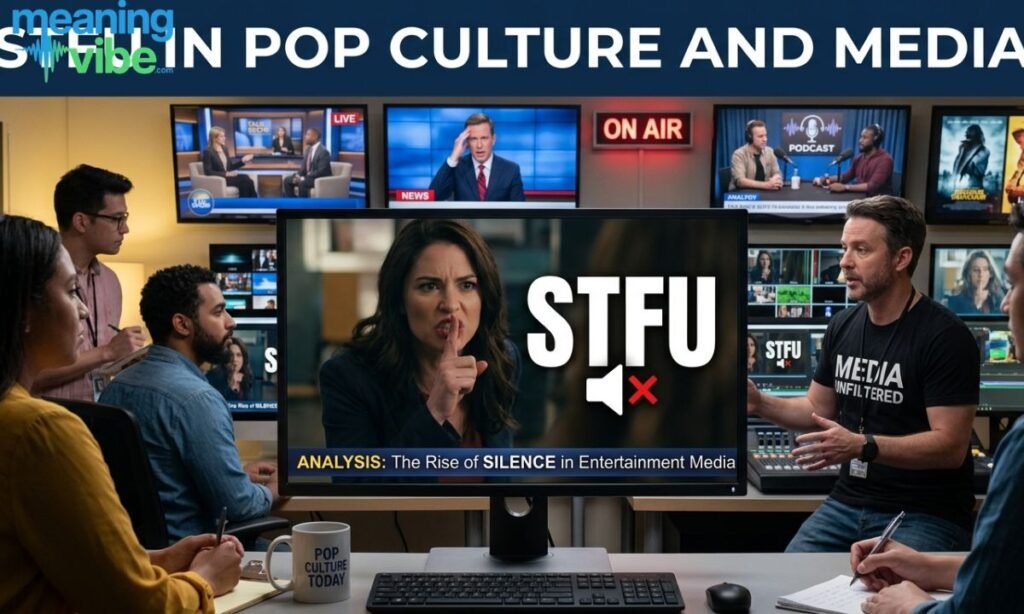
STFU appears in memes, YouTube videos, gaming culture, and TikTok trends. Its edgy humor makes it perfect for viral content, though it remains firmly informal.
On TikTok, seeing “stfu this is so funny” in a comment is a genuine compliment — it means the content was surprising or hilarious enough to provoke that kind of reaction. In memes, STFU is rarely literal; instead, it expresses shock, excitement, or exaggerated disbelief.
It has also made its way into song lyrics, podcast moments, and social media captions — firmly cementing its place in the vocabulary of modern pop culture.
Risks of Using STFU
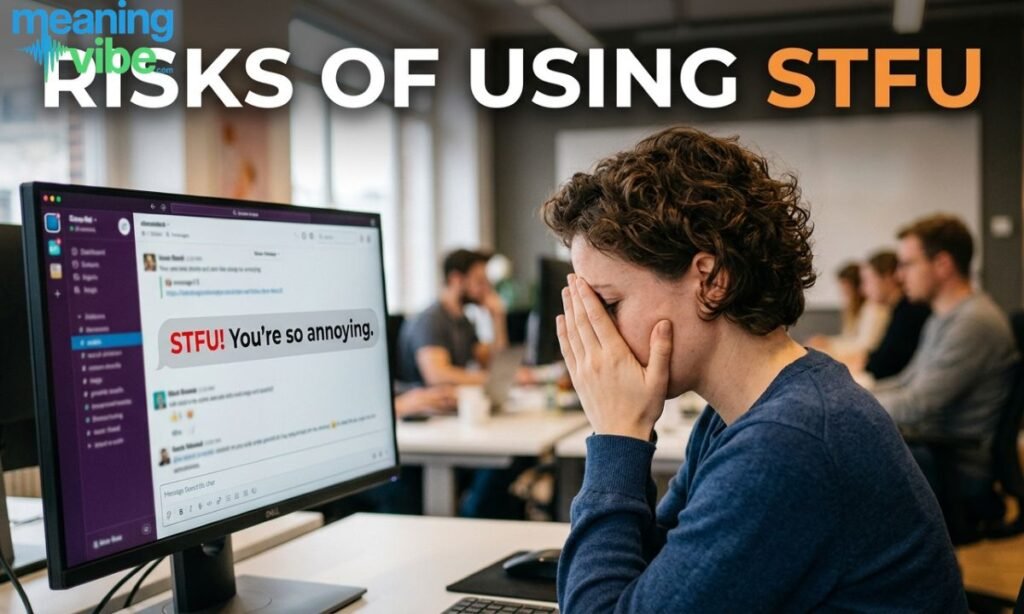
Like all strong language, STFU comes with real risks if used carelessly:
- Damaging relationships — it can come across as genuinely hostile if the other person doesn’t share your humor.
- Professional consequences — sending “stfu” in Slack, Teams, or email can damage your reputation; even joking, it may look disrespectful in professional settings.
- Generational misreading — older users may interpret it literally and see it as outright rude, even when it was meant humorously.
- Platform violations — in public comment sections on brand pages, STFU can get your comment reported or your account flagged.
STFU vs. Other Slang Words
| Slang | Meaning | Key Difference from STFU |
| SMH | Shaking My Head | Expresses disbelief; doesn’t tell someone to stop talking |
| GTFO | Get The F*** Out | Tells someone to leave, not to be quiet |
| WTF | What The F*** | Expresses confusion or shock, not a command |
| Bruh | Expression of disbelief | Softer, reacts to absurdity without commanding silence |
| OMG | Oh My God | Pure surprise or excitement, no negative command |
| LOL | Laughing Out Loud | Always light and humorous, never aggressive |
Custom Example Sentences Using STFU
Here are realistic, natural-use examples across different platforms:
WhatsApp:
Person A: “Did you see Mark’s dance video?” Person B: “STFU, it was hilarious! 😂”
Instagram DM:
Person A: “I can’t believe you ate all the pizza.” Person B: “STFU, it was mine anyway!”
TikTok Comment:
“STFU this is the best thing I’ve seen all week 😭”
Gaming Chat:
“Everyone STFU and focus — last round!”
Text Message (shocked reaction):
“STFU you actually got the job?! I’m so proud of you 🎉”
How to Use STFU Safely
Follow these simple rules to make sure STFU lands the way you intend:
- Know your audience — never use it with someone you don’t know well.
- Add an emoji — 😂 or 😳 immediately softens the tone and signals you’re joking.
- Avoid professional spaces — work chats, emails, and formal messages are completely off-limits.
- Use it sparingly — overusing strong language dilutes its impact and can come across as aggressive.
- Read the room — if the conversation is already tense, STFU will escalate, not defuse.
- Never use it on brand pages — public comments can get flagged or reported.
Cultural Insights on Text Slang

Digital communication has fundamentally changed how humans express emotion. Without body language, voice tone, or facial expressions, people have developed shorthand systems — abbreviations, emojis, GIFs — to compensate. STFU is a prime example of this evolution.
What started as a blunt command in early internet chatrooms has transformed into a multi-layered expression that can mean frustration, humor, shock, or even affection between close friends. Understanding that shift isn’t just about knowing slang — it’s about understanding how digital culture communicates emotion in 2026.
Related Internet Acronyms to Know
| Acronym | Meaning | Common Use |
| SMH | Shaking My Head | Disappointment |
| TBH | To Be Honest | Sharing opinions |
| IMO | In My Opinion | Casual takes |
| NGL | Not Gonna Lie | Honest confession |
| IRL | In Real Life | Offline context |
| DM | Direct Message | Private messaging |
| TFW | That Feeling When | Relatable moments |
| FOMO | Fear Of Missing Out | Social anxiety |
| AFK | Away From Keyboard | Not available |
| FYI | For Your Information | Sharing a quick fact |
Conclusion
STFU is more than just four letters — it’s a dynamic, context-driven expression that reflects the full emotional range of digital communication. Whether it signals genuine frustration, playful shock, or uncontrollable laughter depends entirely on who’s saying it, where, and how. In 2026, understanding internet slang like STFU means reading the room, checking the emoji, and knowing your audience. Use it with the right person in the right moment, and it lands perfectly. Use it carelessly, and it can cause real misunderstandings. Smart texting is always about knowing not just what to say — but when and how to say it.
Frequently Asked Questions
What does STFU mean in texting?
It stands for “Shut The F*** Up” — a blunt, informal way to tell someone to stop talking or to react with shock.
Is STFU always offensive?
No — among close friends it’s often playful and humorous; context and tone make all the difference.
Can STFU be used as a compliment?
Yes — saying “STFU, that’s amazing!” is a way of expressing genuine excitement or disbelief.
Is STFU appropriate in professional settings?
Absolutely not — it’s considered highly unprofessional and should never appear in work emails, Slack, or formal messages.
What’s the difference between STFU and GTFO?
STFU means “be quiet,” while GTFO means “get out” — different commands with different emotional weight.
Can emojis change the meaning of STFU?
Yes — “STFU 😂” reads as playful, while “STFU.” with no emoji can feel aggressive or serious.
How should I respond if someone sends me STFU?
Stay calm, check the emoji and tone, consider your relationship, and respond accordingly — either playfully or by asking for clarification.
Is STFU used more by Gen Z?
Yes — Gen Z uses it most frequently in memes, TikTok comments, Discord, and casual group chats as part of everyday digital language.
Are there polite alternatives to STFU?
Yes — phrases like “please be quiet,” “hold on,” or “let me finish” convey the same idea without strong language.
What platforms is STFU most common on?
TikTok, Instagram, Discord, WhatsApp, Snapchat, and gaming chat platforms are where it appears most frequently.

David Smith is a writer with 4 years of experience in researching and explaining the meanings of words, names, and phrases. He is passionate about language and enjoys exploring the origins and true meanings behind everyday terms.
